
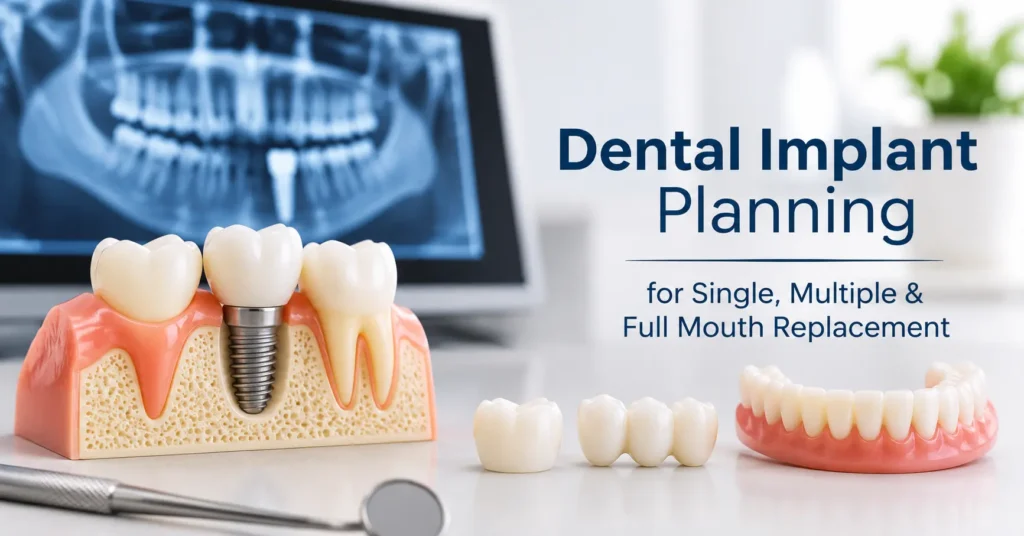
Replacing missing teeth involves more than choosing an artificial replacement. The missing tooth’s position, jawbone condition, gum health and bite alignment all play a key role in determining the right treatment approach. This is why dental implant planning can differ from one patient to another. For someone with a single missing tooth, the dentist may recommend an individual implant with a crown. If several teeth are missing, the dentist may consider an implant-supported bridge. For patients who have lost most or all of their teeth, full-mouth implant rehabilitation may be a suitable option after a detailed examination. Understanding these differences can help patients exploring dental implants in Vasna Bhayli learn what happens before treatment begins and which factors influence the planning process.
How Does Dental Implant Planning Work?
Dental implant planning begins with a detailed assessment of the patient’s oral health and the area where teeth are missing. The dentist evaluates whether the available bone and surrounding tissues can support an implant and determines the most appropriate replacement option.
The planning process generally includes:
- Initial consultation: Discussion of dental concerns, medical history, previous treatments and expectations.
- Oral examination: Assessment of gum health, remaining teeth, jaw structure and bite alignment.
- Diagnostic imaging: Dental X-rays and CBCT imaging, when clinically indicated, help evaluate the jawbone and surrounding anatomical structures.
- Implant selection: The dentist determines the number, size and position of implants required.
- Prosthetic planning: The type of replacement, such as a crown, bridge or implant-supported denture, is selected.
- Treatment scheduling: The dentist plans any necessary preparatory procedures, such as tooth extraction, gum treatment or bone grafting.
This assessment helps establish a treatment approach based on individual clinical requirements rather than following the same procedure for every patient.
How Are Dental Implants Planned for a Single Missing Tooth?
When only one tooth is missing, the dentist generally evaluates the available bone, surrounding teeth and gum condition before deciding on implant placement. An individual dental implant is usually placed in the area of the missing tooth and supports a dental crown that restores its appearance and function.
What Factors Are Checked?
- Bone availability: Sufficient bone height and width are important for implant stability.
- Gum condition: Healthy surrounding gums help support the implant and maintain the appearance of the replacement tooth.
- Adjacent teeth: The position and condition of neighbouring teeth influence the available space for the implant crown.
- Bite alignment: The replacement tooth must fit properly with the opposing teeth to distribute chewing forces appropriately.
How Is the Implant Position Decided?
The dentist evaluates the location of the missing tooth and surrounding anatomical structures to determine the appropriate implant position and angle. For a front tooth, appearance and gum contour are particularly important. For a back tooth, chewing forces and available bone are major considerations. Depending on the condition of the extraction site, an implant may sometimes be placed immediately after tooth removal. In other situations, the area may need time to heal before implant placement.
What Is the Implant Planning Process for Multiple Missing Teeth?
When multiple teeth are missing, implant planning becomes more detailed because the dentist needs to consider the position of each gap and how chewing forces will be distributed. Replacing every missing tooth with an individual implant is not always necessary. Depending on the clinical situation, different treatment approaches may be considered.
Common Treatment Options
1. Implant-Supported Bridge
An implant-supported bridge can replace several adjacent missing teeth using strategically positioned implants. The bridge is supported by implants rather than relying on natural teeth for support.
2. Individual Dental Implants
When missing teeth are located in separate areas of the mouth, individual implants may be considered for each gap.
3. Combined Treatment Approach
Some patients may benefit from a combination of individual implants and implant-supported bridges, depending on the location of missing teeth and available bone.
What Makes Multiple Implant Planning Different?
The dentist considers several factors before finalising the treatment:
- Implant spacing: Appropriate spacing is important for maintaining healthy bone and gum tissues around implants.
- Chewing forces: Implant positions are planned to distribute biting pressure effectively.
- Bone availability: Bone conditions may vary between different areas of the jaw.
- Treatment sequence: Implant placement and restoration may be completed in stages depending on healing requirements.
A detailed treatment plan helps patients understand how different missing teeth will be replaced and what to expect during each stage.
How Are Dental Implants Planned for Full Mouth Tooth Replacement?
Full-mouth implant rehabilitation may be considered when most or all teeth are missing or when the remaining teeth cannot be restored successfully. Unlike replacing a single tooth, this treatment requires planning for the entire dental arch. The dentist needs to consider jawbone availability, bite relationship, tooth arrangement and the final appearance of the replacement teeth.
What Are the Main Full-Mouth Implant Options?
1. Fixed Implant-Supported Bridge
A fixed bridge is attached to strategically placed dental implants and is designed to remain in the mouth. The number and position of implants depend on the patient’s bone condition and treatment requirements.
2. Implant-Retained Overdenture
An overdenture is a removable denture that attaches to dental implants for improved stability and retention compared with a conventional removable denture. The choice between these options depends on oral health, bone availability, patient expectations and clinical suitability.
How Is Full-Mouth Implant Treatment Planned?
The dentist evaluates:
- Jawbone condition: Bone dimensions are assessed to identify suitable implant positions.
- Implant number and distribution: Implants are positioned to provide appropriate support for the replacement teeth.
- Bite relationship: The upper and lower jaws are evaluated to plan comfortable chewing and proper tooth contact.
- Smile appearance: Tooth shape, size, arrangement and gum visibility are considered.
- Preparatory procedures: Extractions, gum treatment or bone grafting may be required in certain cases.
The treatment plan also considers temporary teeth, healing periods, the final restoration and follow-up appointments.
What Factors Affect Dental Implant Planning?
Not every patient has the same oral condition. Several factors influence the implant treatment approach and the expected outcome.
Bone Quantity and Quality
Dental implants require sufficient supporting bone for stability. If the available bone is inadequate, procedures such as bone grafting or sinus augmentation may be considered.
Gum and Oral Health
Healthy gums are important for implant treatment. Existing gum disease, untreated decay and oral infections may need to be addressed before implant placement.
General Health and Medical History
Certain medical conditions, medications and lifestyle habits can influence healing. Diabetes management and smoking habits, for example, should be discussed during the initial consultation.
Location of Missing Teeth
The position of missing teeth influences implant design and placement. Front teeth require careful aesthetic planning, while back teeth must withstand considerable chewing forces.
Bite Alignment and Teeth Grinding
Bite pressure and habits such as teeth grinding can affect the forces placed on dental implants. The dentist may recommend additional measures, such as a protective night guard, when appropriate.
Treatment Expectations and Budget
The number of implants, type of restoration and any additional procedures influence the overall treatment plan and cost. Discussing expectations and budget during consultation helps identify suitable options.
How Does 3D CBCT Imaging Help in Dental Implant Planning?
CBCT (Cone Beam Computed Tomography) provides three-dimensional images of the jaw and surrounding structures. Unlike conventional two-dimensional dental X-rays, it allows the dentist to examine bone dimensions and anatomical details from different angles. When clinically indicated, CBCT imaging can support dental implant planning by helping the dentist evaluate:
- Bone dimensions: Available bone height, width and shape at the proposed implant site.
- Nerve location: Important anatomical structures in the lower jaw.
- Sinus position: Particularly relevant when planning implants in the upper back jaw.
- Surrounding anatomy: Other anatomical features that may influence implant placement.
This information helps the dentist assess suitable implant positions, dimensions and angles before surgery. At Ensō Dental Care, an in-house CBCT scanner supports three-dimensional assessment when required for implant planning. The findings are considered alongside the clinical examination to determine the appropriate treatment approach.
Conclusion
Dental implant treatment depends on the number and location of missing teeth, jawbone condition, gum health and bite alignment. Whether replacing a single tooth, multiple teeth or a full set of teeth, proper examination and treatment planning help determine the right approach. At Ensō Dental Care, implant treatment is guided by Dr. Vrinda Maheshwary, with advanced diagnostic facilities, in-house CBCT imaging and Osstem implant systems. Patients considering dental implants in vasna bhayli can consult the clinic to understand suitable treatment options and receive a personalised treatment plan based on their dental needs.
Frequently Asked Questions
Q1. How is a dental implant planned for one missing tooth?
The dentist examines the missing tooth area, checks the surrounding gums and evaluates the available jawbone. Based on the findings, the implant position, size and final crown are planned.
Q2. Can multiple missing teeth be replaced with dental implants?
Yes. Multiple missing teeth can be replaced using individual dental implants or an implant-supported bridge. The appropriate option depends on the location of missing teeth, bone availability and bite conditions.
Q3. Are dental implants suitable for full-mouth tooth replacement?
Dental implants can be used for full-mouth tooth replacement in suitable patients. Options include fixed implant-supported bridges and implant-retained overdentures. A detailed examination is required to determine suitability.
Q4. Is CBCT imaging necessary before dental implant treatment?
CBCT imaging is recommended when additional three-dimensional information is needed for implant planning. It helps evaluate bone dimensions and important anatomical structures, allowing the dentist to plan implant placement more accurately.
Q5. How long does dental implant treatment planning take?
The time required depends on the complexity of the case. A straightforward single-tooth case may need fewer planning appointments, while multiple implants or full-mouth rehabilitation may require additional examinations, imaging and preparatory procedures.

One Response